
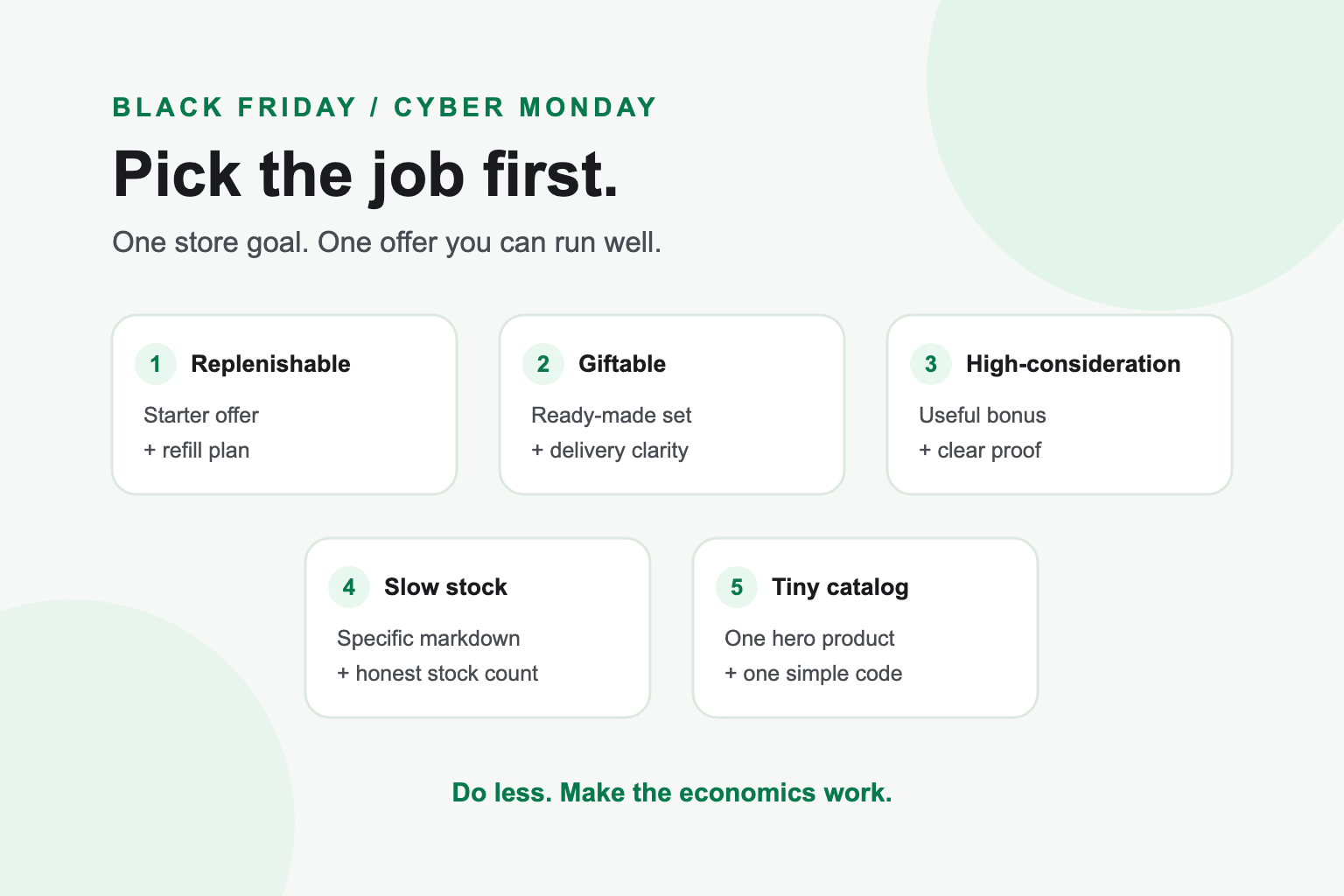
Most lists of Black Friday promotion ideas assume you have time to run flash sales, influencer campaigns, daily emails and a new landing page all at once. A one-person store usually does not. This guide is a menu, not a checklist. Choose one use case, build one offer and test it in checkout. For the preparation calendar, coupon setup, emails and store checks, use our solo-store BFCM checklist.
First, decide what the promotion should do
Is the job to bring in a first-time buyer, get a previous buyer back, raise order value, or free up cash tied in old inventory? Those are different jobs. The deepest discount is rarely the right answer to all four.
| What you sell | A workable offer | Watch out for |
|---|---|---|
| Refillable goodsCoffee, pet supplies, skincare | Starter kit or a modest first-order code | Assuming a second order before you have evidence |
| Giftable goodsHomeware, accessories, specialty food | Curated gift set with a clear delivery cutoff | Packaging and shipping eating the bundle margin |
| Expensive, considered purchasesFurniture, equipment, premium goods | Useful accessory or setup help | Huge discounts that undermine trust and cash flow |
| Old or seasonal stock | Marked-down, named collection | Discounting your best sellers by accident |
| One or two hero products | One straightforward code or relevant add-on | Building a complex campaign for a tiny catalog |
On a phone, swipe the table sideways to compare each offer with its main risk.
For any route, write the offer on one line: “Buy this product, get this benefit, until this date, subject to these terms.” If you cannot do that, shoppers will struggle too.
1. Replenishable products: sell the first use, then earn the refill
If people naturally need more in 30, 60 or 90 days, a starter kit can introduce the product without training them to expect a permanent 30% discount. A coffee store might pair one bag with filters; a skincare store might sell a small routine; a pet store might offer a trial pack. Price the kit so the first shipment is at least close to contribution break even after product cost, packing, payment fees, shipping subsidy, discount and acquisition cost.
Only add a subscription if the product and customer genuinely suit it. Make renewal timing, price and cancellation clear. Shopify describes subscriptions and bundles as BFCM options, but both add setup and support work. For a solo merchant, a simple replenishment email after delivery may be enough.
Do this: Offer one starter kit, include a useful usage guide in the order, and set a reminder for when a refill would actually be needed. A customer who has not yet received the first order does not need a “buy again” pitch.
2. Giftable goods: make the decision easier
A gift buyer may not know which variant, size or combination to choose. Put two or three proven products into a named gift set and show who it is for, what is inside, total price, delivery cutoff and return terms. The offer can be a modest bundle saving or free gift wrapping. If your margin is thin, convenience can be the benefit without a large markdown.
Do not invent a “mystery box” just to move stock that customers may dislike. If you bundle, check the available stock of every component before promising it; Shopify notes that bundle availability depends on component inventory. A sold-out item can break the entire set.
Do this: Publish one gift page with a clean mobile image, recipient guidance and an honest shipping deadline. If gift orders are unusual for your store, add a gift card option rather than building a new packaging operation overnight.
3. High-consideration products: remove a real obstacle
For furniture, equipment or premium products, a small discount may be less persuasive than clarity. Show dimensions in context, delivery and assembly details, warranty or return terms, and a real customer photo if you have permission. Offer a useful accessory or setup help only if it solves a buyer problem and you can deliver it.
A customer spending hundreds of dollars will notice a vague “up to 70% off” banner next to unclear product details. Prettifai the product page before pushing traffic: make the image, product choice, price, delivery information and primary button easy to understand on a phone. Keep the offer and its exclusions visible where the buying decision happens.
Do this: Choose one hero item and answer the three questions customers ask most often. Add a limited bonus only if its cost is lower than the value it creates.
4. Slow-moving inventory: make a clean exit
If the goal is to recover cash and shelf space, use a clearly named clearance collection with exact prices or markdowns. Keep current best sellers out of it. The relevant calculation is the cash you can recover after fulfillment and fees, compared with holding or disposing of the stock. Do not say “only five left” unless that is true and inventory tracking is reliable.
Be direct about final-sale terms where they apply and where local rules allow them. Put product condition, variants and return policy on the product page. A clearance order that becomes a return or support dispute may be worse than waiting another week.
Do this: Pick a small set of aging products, set an explicit end date, and stop when the stock or margin floor says stop. A storewide coupon makes this harder to control.
5. A tiny catalog: feature one thing well
If you sell one or two products, you do not need a “12 days of deals” campaign. Feature the product customers already understand. Use one clear coupon, a relevant add-on or an early-access window for eligible previous buyers. In Shopify, discount codes can be limited by products, customer eligibility, dates and usage. Test your exact setup in a cart, including whether other discounts combine.
Past customers are a sensible first audience, but send promotions only to people eligible to receive marketing and respect unsubscribes. Shopify keeps marketing subscriber status separate from order history. One useful launch email with a direct product link is worth more than a week of repetitive blasts.
Do this: Send one clear email, share the same offer on your store, and spend the saved time checking stock, fulfillment and customer questions.
Can you sell the first order at break even and profit later?
Sometimes. Treat it as a measured acquisition investment, not a Black Friday trick. “Break even” should mean contribution after the discount, product, packaging, shipping subsidy, payment fees, expected returns and acquisition cost. Revenue minus ad spend is not enough.
A $60 order costs $24 to make, $8 to pack and ship, $2 in payment fees and $6 in discount. That leaves $20 before ads and returns. If the ad costs $20 per acquired order, the first order has no contribution left; returns make it negative. A later $60 order might contribute $26 without the first-order discount and ad spend. That later order is an opportunity, not money already earned.
Before accepting break-even acquisition, ask whether the product naturally gets reordered, how many comparable first-time buyers have actually returned, how long that took, and whether you can fund fulfillment while waiting. Use your own customer cohort and repeat-purchase reports where available; Shopify explains repeat customer rate as the share of unique customers who bought more than once. Compare BFCM buyers with other first-time buyers, because bargain hunters may behave differently.
If you have no repeat-purchase history, a durable product, or limited cash, require profit on the first order. If you do test an acquisition offer, cap the number of discounted orders or the spend and write a stop rule before launch. Never assume that collecting an email guarantees another purchase.
How to turn a BFCM order into a second order
The repeat order starts with a first order that arrives on time and matches the promise. Send a useful order update, make support easy to reach, and fix fulfillment problems first. Then follow up according to the product’s actual use cycle and the customer’s marketing consent.
- After delivery: Share a short usage or care tip tied to the product purchased. Ask for a review only after the buyer has had time to try it.
- At the likely next need: Suggest the refill, compatible accessory or next item. A coffee refill message after a month makes sense; a sofa replacement message does not.
- Measure the cohort: Record first-order contribution, returns, repeat orders and second-order contribution for BFCM customers. Review after a realistic product cycle, not three days after Cyber Monday.
You can include a future-use coupon, but calculate that second discount too. A better experience, useful guidance and a relevant next product often do more than another generic code. If customers bought gifts, the buyer and recipient may have different future needs; avoid assuming both want the same follow-up.
Black Friday best practices for a one-person store
Keep your campaign small enough to fulfill. Choose one primary offer, check its margin, make the terms unmistakable, test the exact checkout path and prepare the page that will receive traffic. Email eligible previous buyers before paying for attention. If you use ads, set a maximum cost per order from the arithmetic above; auctions can become more competitive around BFCM. A relevant partner can be useful when your own audience is small, provided you count any commission in the offer cost.
Start before the sale. The BFCM preparation guide has the calendar and a signup for a future downloadable tasks list. It also covers how to prettifai your store without replacing your live theme at the last minute. Use it after you choose the offer here.
What is the best Black Friday promotion for a small ecommerce store?
The one that fits the product and leaves an acceptable contribution after all costs. For a refillable product, consider a starter offer. For gifts, simplify the choice with a set. For old stock, markdown only that stock. A straightforward code can be enough for a tiny catalog.
Should I run a storewide discount?
Only if the margin works across the whole catalog and you can explain the exceptions. Many small stores are better served by a featured product, named collection or bundle.
Is a break-even Black Friday sale a good growth strategy?
It can be a limited test for a product with proven repeat demand and enough cash to wait for the next order. It is a poor default for durable, one-time or unproven products. Count returns and fulfillment in the first-order result.
Sources and further reading
- Shopify: Black Friday promotion ideas — offer types, bundles and subscriptions.
- Shopify Help Center: Discount codes — scope, dates, usage limits and eligibility.
- Shopify Help Center: Subscriber list management — marketing consent status.
- Shopify: Customer retention strategies — repeat customer metrics.