
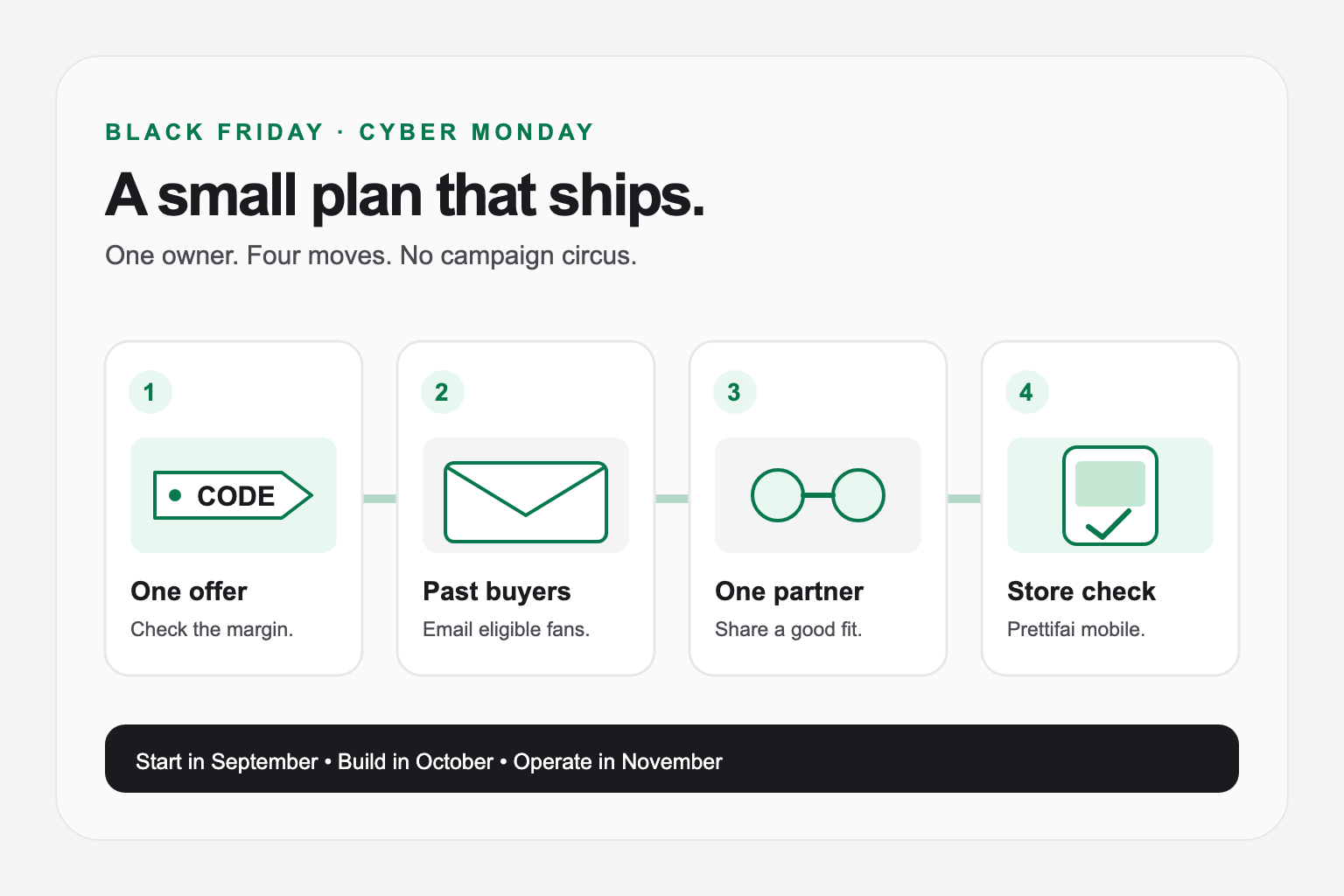
Most BFCM advice assumes a marketing team, a designer, and a big ad budget. This Black Friday checklist is for the owner who packs orders and answers customer messages alone. A good sale that you can actually fulfill beats a complicated campaign that takes over your month.
Start early, with a small plan
September is for decisions, October is for setup, and November is for checking and sending. That is enough structure. Shopify’s 2025 holiday research found that 26% of shoppers planned to begin holiday shopping before the end of September. You do not need to launch a discount in September, but waiting until Thanksgiving week to decide what to sell leaves you no time to check the offer, stock, and store.
Write down three numbers before you plan creative: units you can ship, gross profit per order before marketing, and the maximum you can spend to acquire an order. Then choose one hero product or small collection with stock and healthy margin. Do not build five landing pages for five different audiences unless that work already exists.
Choose the product, calculate a safe discount, create and test the code, draft one email, and place a test order on your phone. Those five jobs come before new ad creative or elaborate graphics.
Build one coupon that makes money
Customers need a clear reason to buy now. For a solo store, a single coupon is easy to explain in email, on your site, and through a partner. In Shopify’s Discounts settings, set the code’s eligible products, start and end time, minimum spend if useful, use limits, and combination rules. Put the same terms wherever you mention the offer.
Do the arithmetic first. Suppose an item sells for $50 and product, shipping subsidy, and processing cost total $27. You have $23 before discount and advertising. A 20% coupon removes $10, leaving $13 before ads. If an order costs $15 in ads, you lose money. In that case, use a smaller discount, a minimum order threshold, a bundle, or no paid ads. A coupon is a tool, not a requirement to discount every item.
Test the exact code in a real cart before announcing it. Check excluded items, shipping, other automatic discounts, and the expiry time. Shopify allows some discounts to combine when configured, so do not assume your code cannot stack. If you promise “20% off,” make sure checkout shows it without a surprise exception.
Email previous customers before buying new attention
Your past buyers already know the product. That usually makes them the first audience worth contacting. Exporting every old order and blasting it is a bad idea: send a marketing email only to customers who can lawfully receive it, respect unsubscribes, and use your platform’s consent status. Shopify separates email subscribers from customers who have not accepted marketing.
One person can run a useful three-email sequence: a short heads-up or early-access note, the launch email with the code and direct product link, and one genuine last-day reminder. If someone bought a replenishable product, mention that product. If they bought a gift item, suggest the relevant gift. Skip fake “exclusive” language and invented scarcity. Send yourself a test email and click every link.
Write those emails in October. When the sale arrives, you should be answering buyers and fulfilling orders, not composing a campaign at midnight.
Expect tougher ad auctions on peak days
Budget as if ads will cost more on Black Friday. Shopify notes that ad costs rise in the weeks leading up to BFCM, and its Facebook ad guide says holiday competition often means a steeper cost per click. Your own channel and product may differ. Google explains how competing bids and relevance affect an ad auction. Watch cost per order, not just cost per click.
If paid ads have already worked for you, set a ceiling based on your margin and watch performance daily. Promote a proven product and offer, preferably to a warm audience you have built earlier. If ads have never been profitable, BFCM morning is a poor time to discover whether a new campaign works. Email and partner referrals can carry more of the load. Do not raise bids just because the calendar says Black Friday.
Try one useful partnership
A complementary small store or creator can put your offer in front of people who already trust them. Think socks with shoes, coffee with mugs, skincare with a bathroom accessories shop. The fit matters more than follower count. Ask one or two people in September or October; last-minute partnership requests are easy to miss.
Make the proposal small: each side features one product in one email or social post, or a creator shares a unique code with a clear commission. Agree on the date, product link, code, attribution, and who handles customer questions. Run the code through the same margin calculation as your main coupon. Do not give a partner a deep discount and a large commission without seeing the combined cost.
Prettifai your store before traffic hits
A prettier storefront does not rescue a weak offer, but a confusing storefront can waste the attention you earn. Before BFCM, prettifai the pages that will receive traffic: homepage or sale collection, the featured product page, cart, and checkout path. On a phone, check the first product image, price, coupon terms, size or variant choice, shipping estimate, return policy, and buy button. If buyers ask the same question repeatedly, answer it on the page.
Use the smallest safe fix. A better crop, clearer headline, visible delivery date, or readable return terms can matter more than a full redesign. If you do need a larger change, Prettifai can build it in a private Shopify draft while the published theme stays live. Review the draft on mobile and desktop, test cart and checkout, and publish only when you are ready. Start that work early enough to inspect it; avoid swapping themes right before the sale.
Your four-stage BFCM calendar
- September: decide. Pick a hero product, check stock and margins, choose one coupon, contact one partner, and list the pages you need to prettifai.
- October: build and test. Create the coupon, write the three emails, check consent, make targeted store improvements, confirm shipping cutoffs, and test a mobile order.
- November 1–26: warm up. Send the heads-up email, confirm partner dates, verify inventory, and check any paid campaign against your margin ceiling.
- November 27–30: operate. Send the launch and honest last-call emails, answer questions, watch stock and checkout, and stop an ad if acquisition cost exceeds your limit.
After Cyber Monday, note revenue, contribution margin, email orders, partner orders, ad cost, and the questions customers asked. That small record will make next year’s BFCM easier. If time runs out this year, protect the offer, email, and checkout checks first.
Quick answers for a one-person store
When should I start preparing for Black Friday 2026?
Start in September if you can. Decide on stock, margin, the offer, and one partner. Build and test in October. A late start is still workable: cut the plan down to one offer, one email to eligible subscribers, and a checked product page.
Should I email all previous customers?
Email all previous customers who are eligible for marketing under the consent rules that apply to your store. Do not treat a past purchase alone as universal permission to send a promotion. Keep unsubscribe handling intact.
Do I need Black Friday ads?
No. Use ads when you know your allowable acquisition cost and have a campaign or audience that has already performed. If the numbers do not work, focus on existing customers and relevant partners.
What is the minimum useful BFCM plan?
One profitable coupon, one clear product page, one tested checkout, and a launch email to eligible customers. Add a partner or paid ads only if you can manage and measure them.
Sources and further reading
- Shopify: BFCM strategies for 2026 — early shopping and campaign planning.
- Shopify: Black Friday promotion ideas and 2026 dates.
- Shopify Help Center: Discount codes.
- Shopify Help Center: Email subscriber list management.
- Shopify: Black Friday ecommerce planning and Black Friday Facebook ads — seasonal ad competition.
- Google Ads Help: Bids and advertiser competition.