
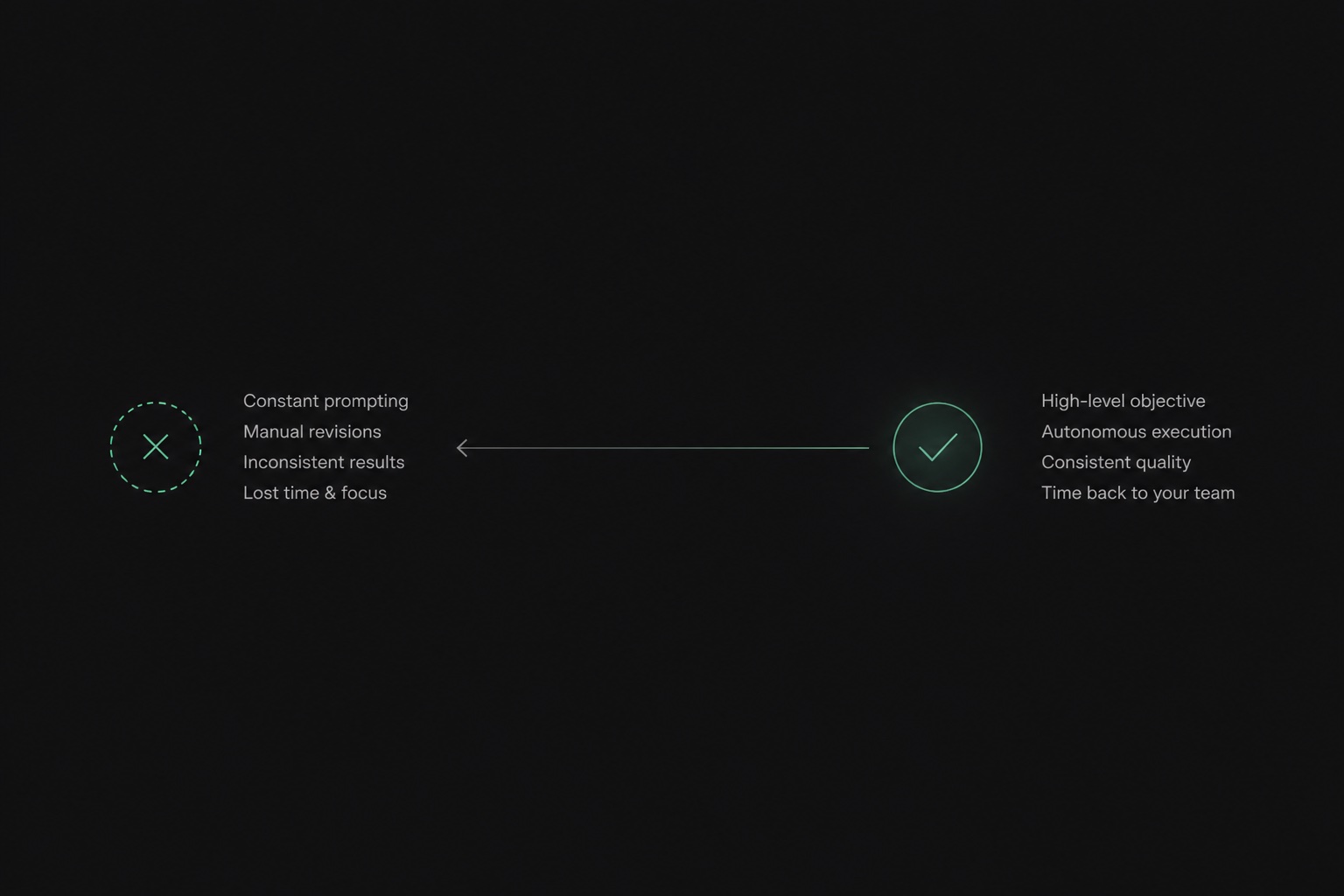
Generative AI removed the blank page. It also introduced a new kind of work: managing the machine that was supposed to save time.
You explain the idea. The model makes a draft. You correct the tone. It removes something important. You paste the old version. It restores too much. You ask for code. You preview the code. Mobile breaks. You describe the break. Three hours later, you have made progress while acting as creative director, product manager, QA tester, copy editor, and deployment engineer.
This is not a failure of chat. Chat is a remarkably useful interface. It is simply not the final form of automation.
Chat-based AI transfers production to the model but keeps management with the user
A capable model can produce excellent text, images, code, analysis, and plans. Yet the default chat loop remains synchronous: prompt, response, judgement, correction, repeat. The model performs a unit of work; the user maintains the objective, context, quality bar, and sequence.
That can be ideal for thinking together. It becomes expensive when the task is operational and repeatable. A merchant does not really want thirty website suggestions. They want the correct changes implemented, checked, and ready to approve.
An AI agent controls a workflow, not merely a turn in a conversation
OpenAI defines agents as systems that independently accomplish tasks on a user’s behalf, using a model to manage workflow execution and tools to gather context or take action within guardrails. Anthropic describes the core loop as plan, act, observe, and adjust.
That difference sounds small. It changes the product completely. A useful website agent must be able to inspect the existing site, decide what evidence it needs, create a bounded plan, edit the correct draft, render the result, detect a failure, retry or recover, and present the merchant with a clear outcome.
The best autonomous systems reduce attention, not human authority
“Autonomous” should not mean “unaccountable.” It should mean the system can handle the routine path without asking the user to supervise every microscopic step. The user still sets the objective, permissions, constraints, budget, approval points, and stop conditions.
A trustworthy agent needs meaningful human control: permission boundaries, legible behavior, and the ability to intervene. Experienced users may automate more routine actions while watching consequential ones more closely. Confidence and oversight can grow together.
A website is where endless prompting becomes especially painful
A website is not one picture. It is a living system of templates, content, code, data, apps, analytics, devices, search visibility, accessibility, and commercial behavior. A change that looks good in one generated screenshot can break another page, slow the storefront, or become impossible to edit in the native builder.
That makes chat-based website building deceptively demanding. The model can create a beautiful hero in minutes. The merchant must still ask:
- Does this use the existing products and brand assets correctly?
- Does it work on the actual theme rather than a disconnected mockup?
- Is the mobile crop good?
- Did any cart, search, navigation, or app behavior regress?
- Can the merchant edit it later?
- Did it change the live site?
- How is it hosted, monitored, updated, and recovered?
Every unanswered question becomes another prompt or another production incident.
The cruelest website problem is paying again for something you already bought
Imagine a merchant invested in a store three years ago. It looked current. The team learned it. Search engines indexed it. Customers linked to it. Products, reviews, tracking, and operations accumulated around it.
Now the design feels dated. The normal industry answer is astonishing: start another website project. Find references. Write another brief. Review more mockups. Rebuild templates. Migrate content. Test integrations. Protect rankings. Pay again. Then repeat when the next visual era arrives.
The alternative is to treat the website as a system that can be continuously maintained, like software, merchandising, or paid acquisition, rather than a building demolished every few years.
Autonomous improvement starts with the website that exists
A capable growth agent should begin by observing the real storefront and its constraints. It should identify opportunities, estimate which ones matter, create an unpublished working version, implement a bounded change, compare before and after, and bring the result back with evidence.
As traffic permits, the loop can become experimental: create a hypothesis, build a safe variant, verify it, route it through approval, measure the agreed metric, learn, and propose the next action. The website improves as an ongoing operational process instead of waiting for the merchant to feel enough pain to commission another redesign.
Current models are ready for bounded autonomy, not magical independence
The honest 2026 view is encouraging and constrained. Stanford’s 2026 AI Index reports large gains on agent benchmarks such as GAIA, but performance still trails the human baseline. METR’s measurements show that model success declines as tasks become longer and less predictable. Production experience favors starting with the simplest composable pattern that works.
In practice, agents are strongest when they have:
- a clear objective and a narrow action surface;
- reliable tools with explicit permissions;
- observable intermediate results;
- short, durable checkpoints;
- tests or visual evidence for success;
- rollback when an action fails;
- human approval before consequential external changes.
A website redesign in a separate draft theme fits this pattern far better than “go change my live business until it looks good.”
The agent’s most important skill is knowing what finished means
Generative quality attracts attention, but completion quality creates trust. The system must know when the page meets the brief, when key interactions still work, when mobile is acceptable, when the code remains editable, and when uncertainty is high enough to stop.
That requires more than one model response. It requires roles, checks, memory, tool feedback, recovery, and a product policy that separates implementation from publication.
The future is not fewer conversations. It is fewer conversations required for routine work
People will still talk with AI to explore strategy, taste, brand, and ambiguous goals. The difference is that a merchant should not have to narrate every pixel and debug every container to receive a professional page.
The true power of AI is not that it can always answer. It is that, inside a well-designed system, it can carry responsibility for a bounded piece of work and return time to the person who owns the business.