
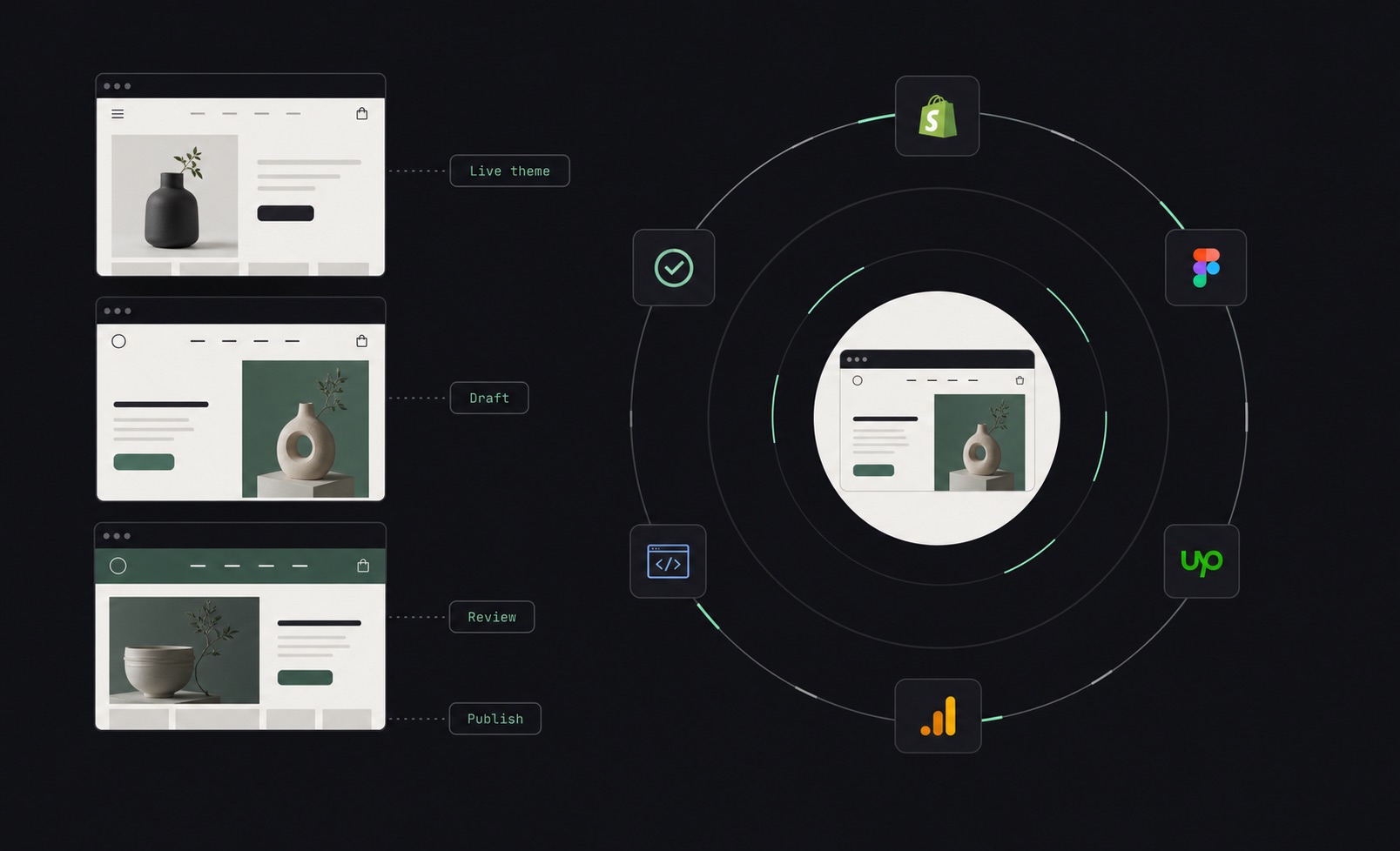
A Shopify redesign is risky only when building and publishing are treated as the same action. They do not need to be. Shopify supports multiple themes in the store’s theme library while only one is published for customers. That separation creates a safe working area for designers, developers, and autonomous agents.
The live store should be treated as a source, not a workspace
Your published theme is the storefront customers currently see. It should provide the design, content, and behavior that a redesign begins from, but it should not be the place where unfinished work is tested.
A safer system records which theme is live, creates a separate draft, and directs every write toward that draft. Customers continue using the published store while the redesign develops elsewhere. Shopify’s own guidance describes unpublished themes as draft themes and gives merchants a distinct action to publish one.
A preview is useful only when it represents the correct draft
“We checked your website” is not enough. A useful review must compare the original page with the exact draft being changed. Otherwise a screenshot can accidentally show the published store, an older draft, or the wrong page.
Prettifai binds each run to a selected source theme and a newly created draft. It captures the original state, applies work to the draft, and reviews the resulting preview on desktop and mobile. This gives each judgement a real before and after.
Visual quality requires checking the page, not merely checking the code
Valid code can still produce a clipped headline, an awkward image crop, a broken mobile menu, or a cart drawer hidden behind another element. Theme work therefore needs two kinds of verification:
- Task verification: did the intended improvement actually appear?
- Regression verification: did anything that worked before stop working?
A reliable redesign process checks the targeted element, the surrounding layout, mobile behavior, and important interactions such as navigation, search, and cart. Code is the implementation; the rendered storefront is the evidence.
Interrupted work should return to a known checkpoint
Long-running automation will encounter network failures, provider outages, and process restarts. The unsafe response is to continue from an uncertain file state. The safe response is to save checkpoints and restart only from a state the system can verify.
Prettifai records durable task boundaries and treats edits as atomic operations. If Shopify rejects a theme asset update, the change is rolled back instead of leaving the local workspace and draft theme inconsistent. If a worker stops unexpectedly, the task can resume from a safe checkpoint.
The merchant should always own the final publishing decision
Autonomous implementation does not require autonomous publication. Those are different permissions. The agent can do the repetitive design and technical work while the merchant retains the business decision: whether and when the new theme becomes the customer-facing store.
This is the model Prettifai follows: the system delivers an inspected draft, and the merchant can preview it, request a rework, leave it unpublished, or publish it through Shopify.