
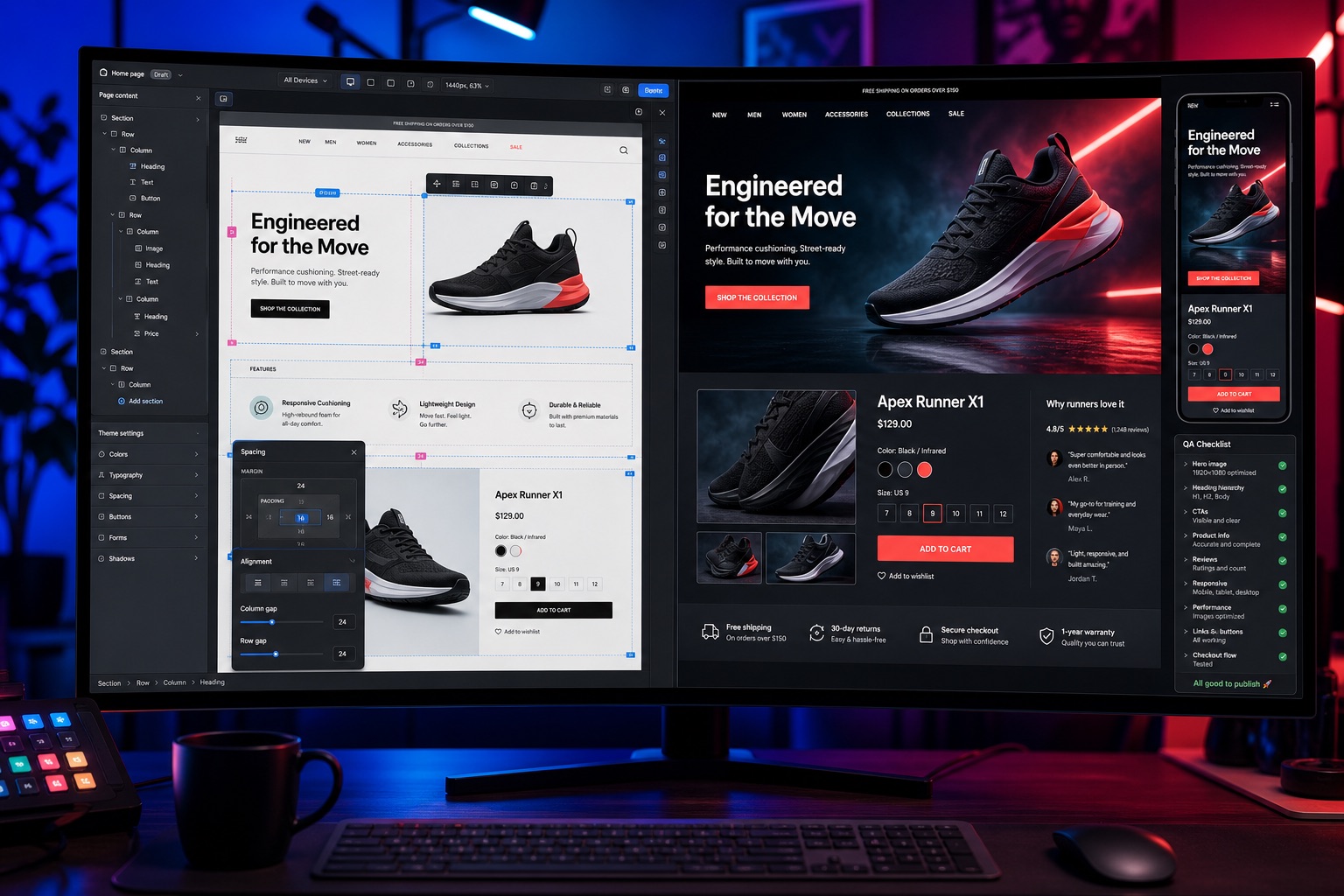
PageFly and Prettifai both aim to help Shopify merchants create stronger storefront experiences, but their products start from different assumptions. PageFly assumes the merchant or marketing team wants a page-building environment. Prettifai assumes the merchant wants the page improved without becoming the builder.
PageFly is a visual creation platform; Prettifai is an autonomous service
PageFly advertises AI page and section generation, a drag-and-drop editor, templates, analytics, heatmaps, A/B testing, and integrations. Those are capabilities inside an ongoing platform.
Prettifai analyzes a selected theme and page, establishes design rules, plans improvements, edits a separate Shopify draft, captures visual evidence, runs quality checks, and delivers the draft for merchant review.
PageFly offers more direct control; Prettifai requires less merchant effort
Direct control is valuable when a team has a clear visual system and someone responsible for execution. A visual canvas makes rapid manual iteration possible.
Prettifai deliberately removes that control from the working phase. The merchant communicates the desired direction and constraints, then evaluates the outcome. That is a better match for merchants who do not want to learn responsive layout or operate another editor.
Both can work with Shopify, but their editing models remain different
PageFly says it runs natively in the merchant’s theme and supports Shopify page types and integrations. Its editor remains the central creation surface.
Prettifai edits the Shopify theme itself and aims to preserve sections, blocks, and settings so merchants can continue using Shopify’s Theme Editor afterward. No proprietary Prettifai page canvas is required for routine edits to the delivered work.
Performance responsibility follows the workflow
PageFly provides performance-oriented features and says its pages support responsive design and lazy loading. The merchant still decides which elements, integrations, media, and features to add.
With Prettifai, performance is part of the agent’s implementation and review scope. That does not guarantee a particular score: a store’s apps, media, theme, and third-party services still matter. It does mean the merchant is not expected to understand the rendering consequences of every component.
The better product is the one that matches your desired role
- Use PageFly if your team wants a mature visual builder, template library, analytics features, and direct control.
- Use Prettifai if you want the design and implementation handled in an unpublished draft, with the final decision left to you.