
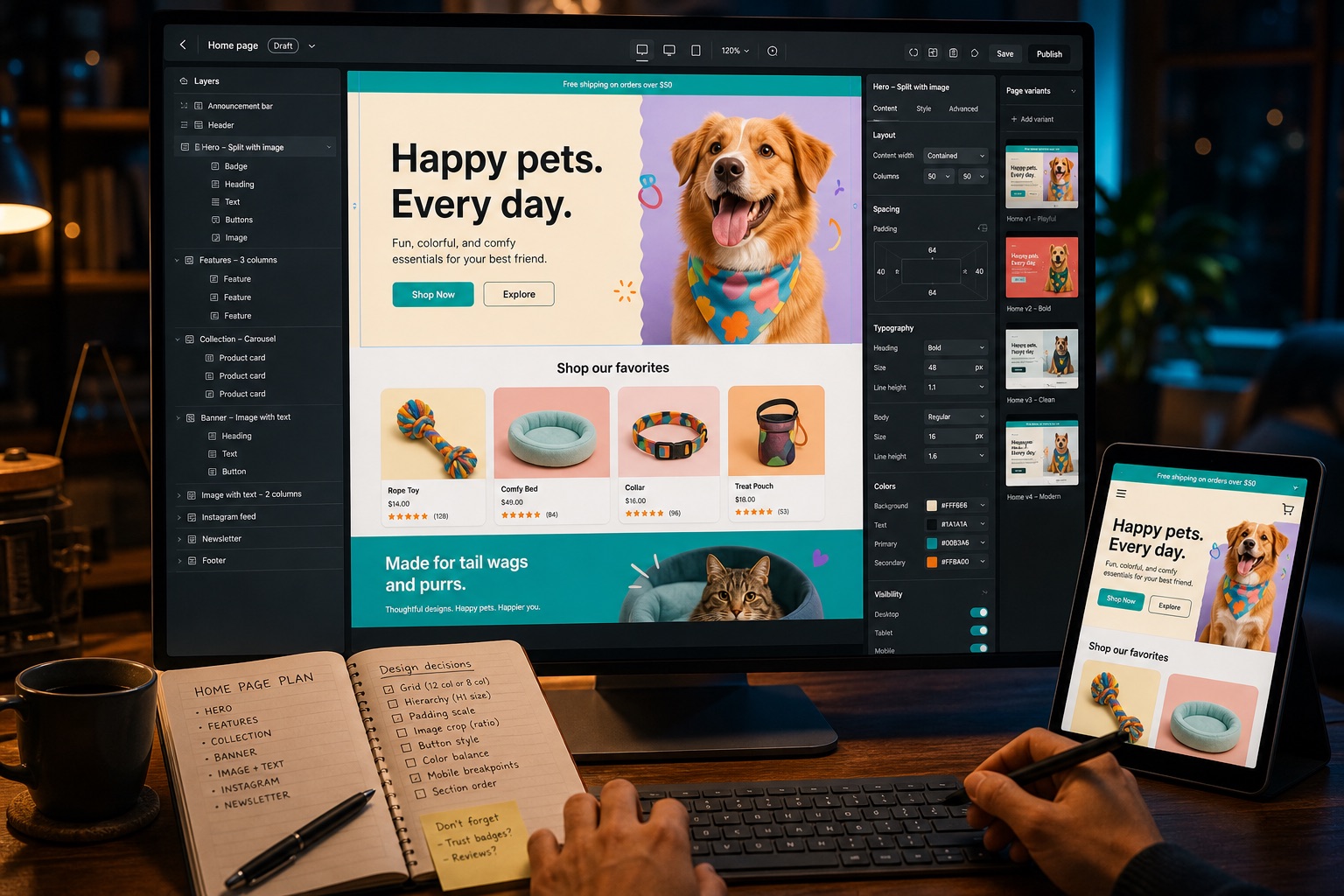
“No code” is often presented as “no technical work.” Those ideas are different. A visual editor replaces syntax with controls, but the merchant still needs a mental model of how webpages behave.
Drag-and-drop changes the interface, not the responsibility
Popular Shopify page builders provide editors, templates, reusable sections, responsive controls, integrations, and increasingly AI-assisted generation. Those features can make skilled teams faster. But someone must still operate them.
The user chooses a template, decides which elements belong together, adjusts the mobile layout, connects apps, reviews the output, and publishes. A page builder transfers implementation capability to the merchant; it does not remove implementation responsibility.
A merchant can avoid code and still face technical design problems
A hero image may look too small even after uploading a larger file because its section container controls the dimensions. A desktop layout may collapse poorly because its cards were designed around fixed widths. A sticky button can cover another control on mobile. None of these problems require the merchant to write code, but solving them still requires an understanding of web layout.
Templates reduce the number of decisions. They do not eliminate the need to recognize when a decision is wrong for a specific store.
More flexibility creates more opportunities for inconsistency
Freedom is a feature for design teams. For a time-constrained merchant, it can become variation without a system: slightly different button radii, drifting spacing, mismatched type sizes, and components that behave differently from page to page.
An autonomous redesign should begin with a design system covering typography, spacing, color, shape, and interaction rules. It should apply that system consistently before judging individual sections.
Page builders are best when control is the product you want
A builder is the right choice for a merchant or team that enjoys constructing pages, wants to iterate directly, and values a broad template or component library. It is also useful for campaign teams producing many layouts themselves.
An autonomous service is a better fit when the goal is the improved page rather than the editing experience. The merchant supplies direction and approval; the system supplies the design labor.
The real comparison is tool versus outcome
Page builders sell leverage. Agencies sell labor. Autonomous agents can combine implementation with repeated inspection, but only when they have the right access, recovery, and quality-control tools. The useful question is not “Which editor has more features?” It is “How much work do I still own after buying it?”