
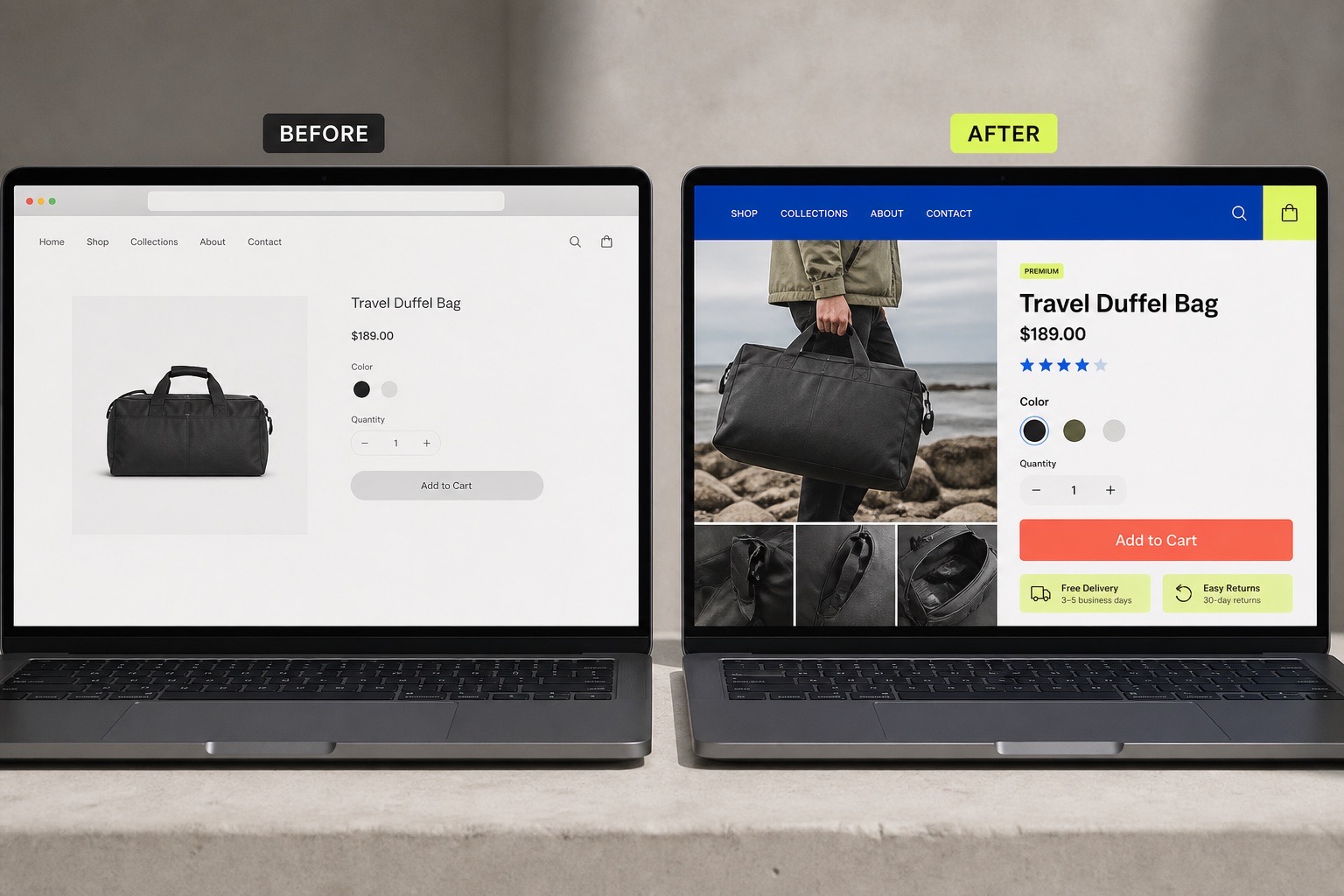
Baymard’s product-page research observed more than 1,300 usability issues during testing and reports that participants repeatedly abandoned sites because of product-page layouts, content, or features. Its benchmark of 344 leading ecommerce sites found 51% had “mediocre” or worse product-page UX.
These are not tiny stores with no resources. They are leading ecommerce sites. A merchant should not assume a familiar theme automatically creates a persuasive product experience.
Every missing answer becomes a reason to postpone the purchase
What does the product look like in use? Which size is right? When will it arrive? Can it be returned? Why is it worth this price? What do other buyers know that I do not?
If the page makes those answers hard to find, the customer must supply confidence themselves. Many will not.
Weak hierarchy makes strong proof effectively invisible
A store may already have reviews, return policies, material details, and excellent photography. If they are buried beneath tabs, inconsistent spacing, or competing elements, their existence does not guarantee they will influence the decision.
Design decides which evidence appears first, which information scans together, and whether the buy section feels deliberate or accidental.
Better product imagery reduces uncertainty that copy cannot
Baymard identifies imagery, image galleries, the buy section, shipping and returns, product variations, descriptions, and reviews as distinct product-page design problems. They must work as one decision system.
For products that shoppers need to imagine using, such as fashion, furniture, beauty, travel, food, or experiences, visual proof does more than decorate. A 2024 peer-reviewed study found that trust played a larger role in purchase intention for experience products than perceived usefulness or ease of use.
Your product is judged through the page that represents it
A weak page can make a differentiated product look interchangeable. A confusing page can make a reliable merchant feel risky. Those perceptions may be unfair, but the shopper cannot inspect the business behind the browser.
Prettifai redesigns the product page in a separate Shopify draft, then checks the rendered result across screen sizes. The merchant sees the completed page and decides whether it deserves to go live.