
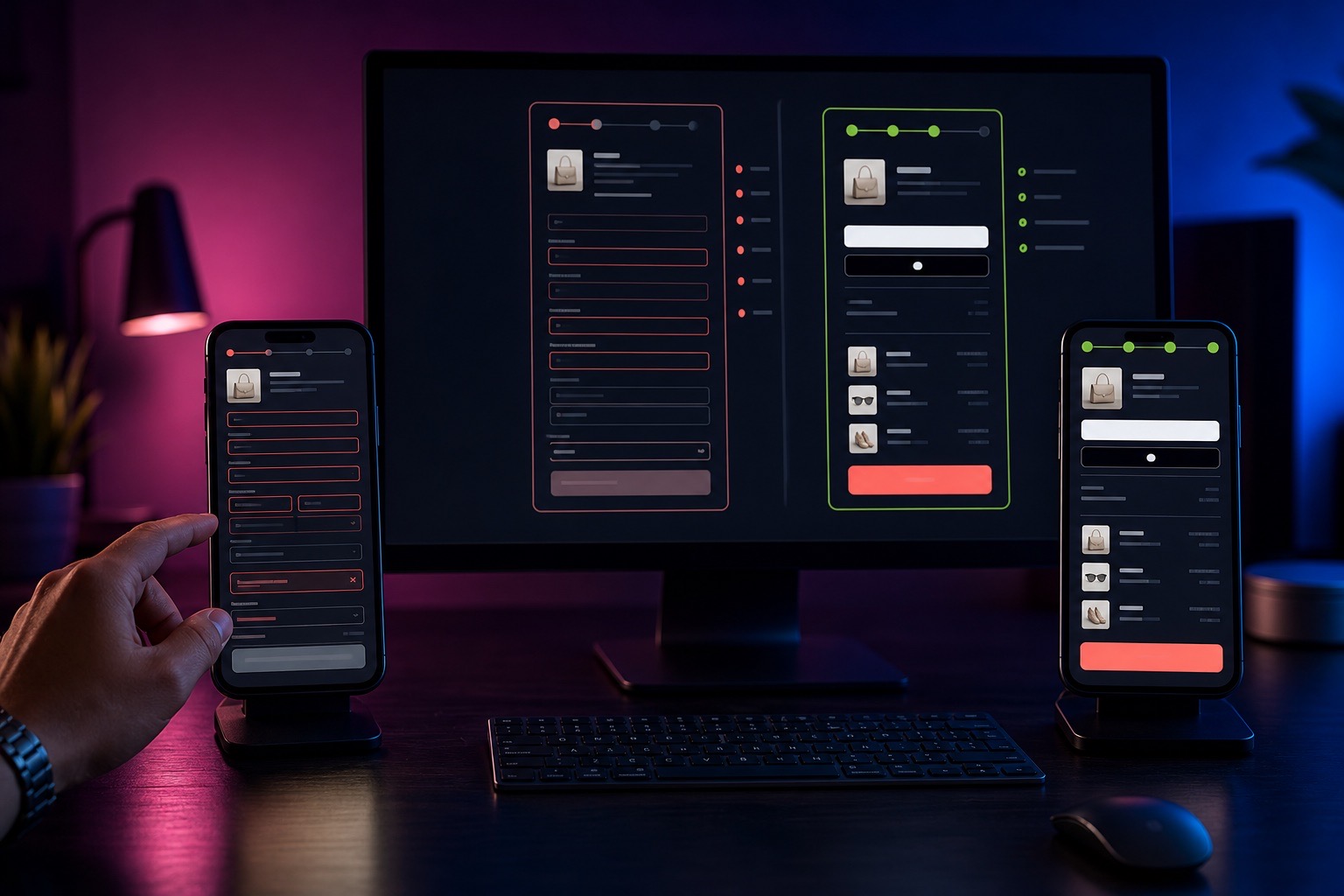
Contentsquare’s 2025 benchmark analyzed 90 billion sessions across 6,000 websites. Across its multi-industry dataset, cost per visit increased 9% while conversion rate decreased 6.1% year over year. That does not prove design caused the decline, and it is not a Shopify-only sample. It does show the environment merchants are operating in: attention is getting harder to acquire and harder to convert.
When acquisition becomes expensive, friction stops being cosmetic
A weak hero, generic message, slow product image, competing popups, and unclear call to action are easy to dismiss as design imperfections. Together they decide whether a new visitor understands the store quickly enough to continue.
The customer will not submit a report explaining that the hierarchy felt uncertain. They leave. Analytics records a short visit, and the marketing team buys another one.
A slow page charges you twice
The first cost is the visitor who does not wait. The second is the marketing and engineering effort spent diagnosing an experience that should have been performance-aware when it was built.
Shopify’s site-speed research says even a half-second improvement can affect conversion. The exact impact varies by store, page, device, traffic source, and starting performance. The useful lesson is not a universal percentage; it is that performance and conversion are connected closely enough to treat speed as a business constraint.
Clarity protects the value of every channel
Paid social, search, email, creators, and AI referrals send visitors with different expectations. A strong storefront makes the product, value, proof, and next action understandable without forcing each visitor to decode a template.
This is why the first redesign target should usually be a high-volume page with a clear commercial role. Improve the page that receives the attention before increasing the attention sent to it.
The safest response is to fix the leak in a separate draft
Prettifai works on an unpublished Shopify theme and returns the result for merchant review. The live store remains untouched while design hierarchy, imagery, mobile behavior, and frontend weight are improved and checked.
No redesign can guarantee a conversion lift. But continuing to pay for traffic while knowingly ignoring visible friction is not a neutral decision either.